30.09.2026
🎨 When paints speak louder than words: how creativity, play and movement bring back to life
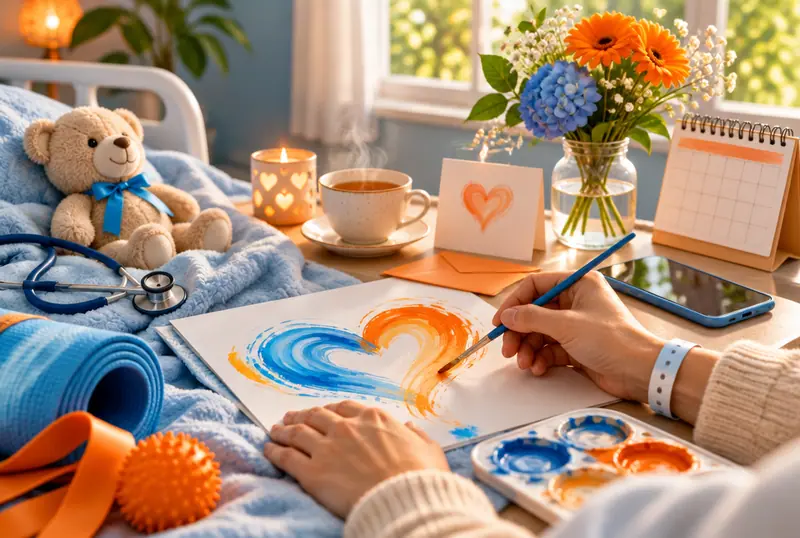
Sometimes, after a hospital room where everything is measured by IV drips and tests, a person learns to hold a brush again. At this point, charity stops being just help for children — it becomes a quiet bridge back to oneself. Rehabilitation does not end at discharge, and support for families at this stage often means no less than the treatment itself. Donations that go toward sessions with a psychologist or adaptive physical education look inconspicuous, but it is precisely they that bring back the taste for morning. For parents, such help for the family is a chance to breathe out and see the child not only as a patient, but as a person who is again happy about something. Imagine a table on which there are not syringes, but soft chalks and sheets of thick paper. A boy who barely spoke for six months suddenly draws a huge sun and labels it in crooked letters. No one demands correct composition from him. Art sessions are arranged so that mistakes do not exist: you can paint the whole sheet black, and then tear a yellow stripe across it. At that moment, it is not artistic talent that works, but the right to express what there are not yet words for. Play works differently. It returns forgotten lightness to the body, and to the head — the possibility of being not strong, but simply eager. A child with limited mobility can control a ball with an adult's help, catch it in a special ring, laugh when the ball rolls under the cupboard. Adaptive physical education is not about records — it is about making the hands feel strength again and the breathing become deeper. Volunteers who come to such sessions often say: they come to help, and leave with the feeling that they received more than they gave. Talking over tea at the table is also therapy. When a family, after long treatment, goes out for the first time into an ordinary room that smells of cookies rather than antiseptic, a quiet restoration of social muscles begins. Conversations about nothing, laughter over trifles, looking at old photographs together. This does not cancel medicines, but adds to them what cannot be bought at a pharmacy — the feeling of ordinary life. The practical side is also important, and it is far broader than a check for treatment. A regular donation, even a small one, allows a charitable organization to plan sessions months ahead, rather than look for money the day before a meeting. Volunteering does not necessarily mean trips to the hospital: you can help organize a celebration, take on photography, bring art supplies. Information support — telling a story, sharing experience, simply forwarding a link to a fundraiser to acquaintances — is also real help. And if there is a skill, for example playing the guitar or making simple crafts, it can be turned into a regular hour that someone will look forward to. Sometimes it seems that real help is only large sums and loud words. But in corridors that smell of paint and modeling clay, where someone stands on a soft mat for the first time, something else is visible. Recovery is a slow process, and it does not like jerks. It needs steady, calm hands and people who are ready to be nearby not for one day. Support for families during this period is not pity, but respect for the pace. Someone will return to drawing in a month, someone in a year, and someone will simply sit nearby and watch others draw. And that is also a result. A charitable organization that builds such sessions usually rests on three things: regular contributions, volunteers' time and the ability not to pressure. Fundraising for materials seems like a trifle compared with treatment, but without paints, balls and tea there will be no such quiet rehabilitation either. If you look closely, there is nothing magical in such sessions. There are brushes enough for everyone. There are adults who do not hurry. There is a child who, for the first time in a long while, does something not because he must, but because he wants to. From these simple components comes a return to life that is not visible in statistics, but is clearly noticeable in the eyes.